

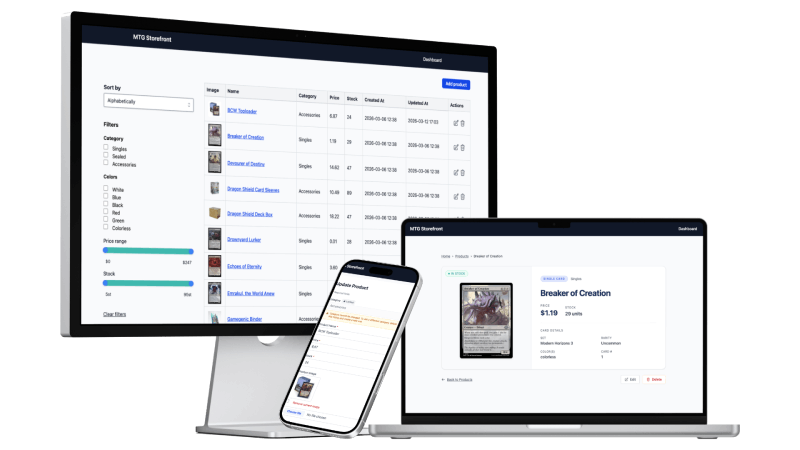
MTG Storefront is a web-based inventory management system for Magic: The Gathering products, designed to enable admin users to efficiently manage product catalogs. The application supports full CRUD functionality across three product categories: individual cards (Singles), boxed sets (Sealed), and gaming accessories. Built as a collaborative group project using Laravel, the system demonstrates proficiency in backend development, database design, and accessibility standards while meeting all specified requirements for inventory management and product filtering. By prioritizing a robust, standards-compliant structure, the interface remains fully functional across various platforms—including mobile and high-zoom environments—ensuring usability and clarity even without a dedicated mobile-first design.
To try it out, follow the instructions in README.md
Feb 2026
3 weeks
Local only
Backend & Integrity:
By implementing strict request validation and DB::transaction(), we ensured data integrity and atomic operations when managing products and their related records.
Database Architecture:
We designed a polymorphic, normalized schema using a base products table and specific extensions for singles, sealed, and accessories to prevent data duplication and ensure scalability.
Frontend & Accessibility:
Built with Blade and Tailwind CSS, the frontend prioritizes WCAG AA compliance using semantic HTML, ARIA attributes, and relative units to ensure the application remains accessible.
Dynamic Filtering:
We developed a multi-dimensional query builder for categories, colors, and ranges, using withQueryString() to ensure that user filter states persist across pagination.
Enhanced Interactivity:
We integrated noUiSlider for accessible range inputs and custom JavaScript helpers to maintain clean URLs and provide real-time UI updates via aria-live, including instant filter responses for a smoother browsing experience.
Relational Complexity:
Mapping complex Eloquent relationships within a polymorphic structure was challenging, especially when filtering multi-color cards. We solved this using nested whereHas subqueries to ensure a maintainable data model.
Defensive Programming:
To prevent application crashes from extreme inputs, we implemented price ceiling enforcement and used floor() and ceil() for range calculations to ensure the UI remained stable.
Custom UX over Defaults:
After receiving feedback, we replaced restrictive browser confirm() prompts with a custom HTML
State Persistence:
A big UX challenge was keeping filters active during navigation. We solved this by using withQueryString() and a helper to strip empty values, ensuring a seamless "back-and-forth" experience.
The Retrofitting Trap:
Adding accessibility features late in the build was a hurdle. It required a deep dive into ARIA live regions and semantic HTML to ensure the site was fully navigable via screen readers and at 200% zoom.
